
The weather is lovely, the light perfect and your dog is amped to chase a ball in the park. Camera in hand you merrily snap away as he jumps, runs and plays. At home the pictures are… underwhelming. Many are blurry, some are missed shots (why find the grass autofocus?!?!).
In reality, the reason your action dog photos are blurry can come down to many things. And, honestly, aren’t that uncommon!
Why is action photography so darn hard?
Action photography, especially with dogs, can be quite a struggle. Dogs vary in speed when running & playing and cameras can struggle with fast erratic motion and motion that moves towards it. And sometimes it is simply just settings and lenses that limit your success. Or even more simply, there is not enough darn light!
And if you mix all those elements the keeper count for action goes WAAAAAY down.
You need more light.
Honestly if you don’t have enough light, action images are going to be filled with motion blur from not only your dog but from you holding your camera as well. The main culprit of lack of light? The position of the sun.
Indeed. The lower on the horizon, the less light spills across the landscape. Wonderful for backlit, dreamy images. Though the later into Golden Hour you go the more the light recedes. Less light = more motion blur.
Also paired with light is weather. Clear open skies will give you LOADS of light to work with. Add some clouds to a full overcast sky and you’ll lose up to a stop of light. Heavy overcast & stormy? You’ll likely lose another stop of light. And there’s nothing you can do about it – because WEATHER!
(FYI Stops is how photography measures light and are found in aperture, shutter & ISO – one stop up DOUBLES the amount of light your camera sensor receives, one stop down HALVES the amount of light incoming. The same works for daylight.)
Your shutter speed is too slow.
This is the easiest reason your dog in action photos are blurry. If your shutter is slower than 1/500th, you’ll likely be capturing more motion than crisp shots. Faster shutters are ideal, but they are so fast that they let in little light. Perfect for ample light scenes, shoddy for instances with less light – your dog will be frozen in action but the image can be severely underexposed. (Aperture & ISO are going to be where you add more light).
If your camera or phone doesn’t give you an option to adjust the shutter speed, you’ll need to default to midday action images of your dog.
TIP: The old adage for camera shake / user blur – hand hold as low of a shutter as the length of your lens. To negate camera shake on a 50mm while hand holding your camera you can go as low as 1/50th shutter speed. With a 70-200mm lens, the lowest shutter to negate camera shake is 1/200th.
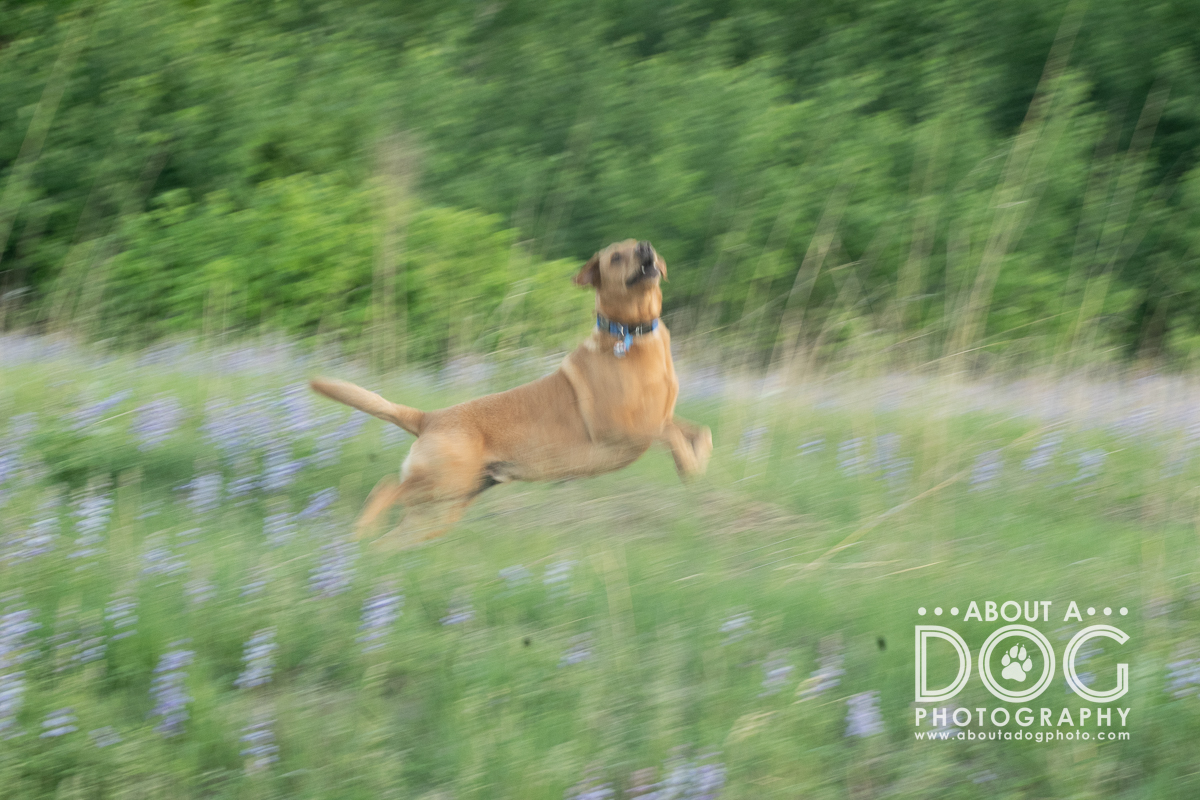
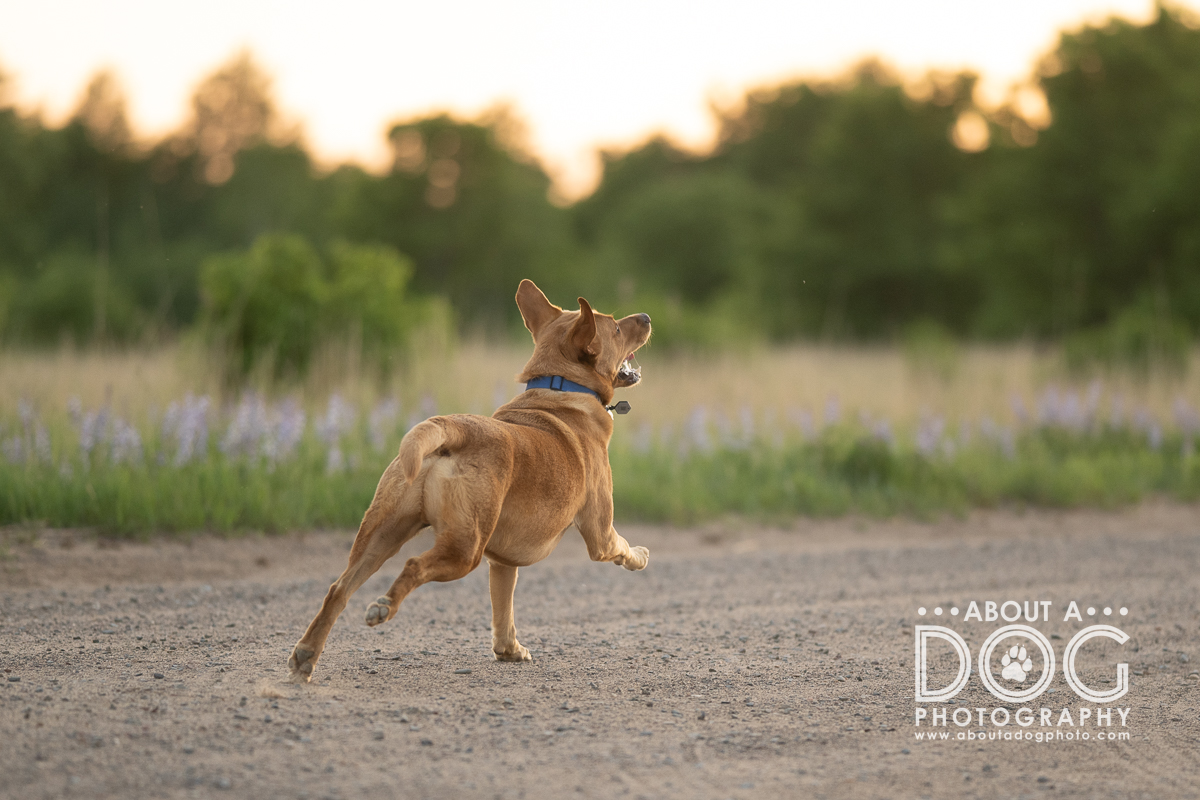
The difference of these images of Dashwood is simply aperture & shutter, same lighting, roughly same spot. Blurry image is f13, shutter 1/40, ISO 1000. 2nd image is f1.8, shutter 1/1600, ISO 1000.
Your location is darker than your eye sees!
Ok, so location doesn’t fix blurry images but it can affect the outcome of your images. Out in a broad grassy area? You’ll likely have less blurry images. Headed into the woods? The deeper you go, the less available light you will have, which means you’ll likely have more blurry images.
If you do want to adventure to the woods for those stunning leaping dogs leaping logs images, consider going in the middle of the day when you’ll have a bit more light filtering to the forest floor. Overhead light will be your friend for action + woods, but be aware of the dappled light that can happen with overhead light. Another way to make the woods a more successful for action is to move closer to the edge of the woods – remember deeper into the woods = less light!
Your focus doesn't focus continuously.
Look at how your autofocus responds to having the shutter half pressed. Focus once then nothing if you keep your shutter half pressed and rotate? Well that isn’t going to be very helpful! You’ll need to land on a continuous autofocus – Servo AF for Canon, Continuous Servo (AF-C) for Nikon & Continous AF (AF-C) for Sony.
PRO TIP: Back button focusing. Remove the focusing from the shutter button and move it to a button your thumb can happily reach. Thumb holds focusing control, continuous autofocus keeps refocusing under thumb pressure and the shutter only fires when your finger compresses the shutter button.
The direction your dog is moving in is helping or hindering you.
If your dog is running back and forth in the yard, left to right in a general parallel movement your camera will more easily pick up your dog’s movements. Essentially the movement is staying within the same focus plane so your camera can easily refocus. The movement that you’ll likely struggle with is when your dog comes running towards your. The faster the dog, the harder to keep their incoming running towards you movements in focus.
PRO TIP: Give yourself ample space and shoot with a longer focal length 70mm or longer. This will give you time to focus on the incoming dog.
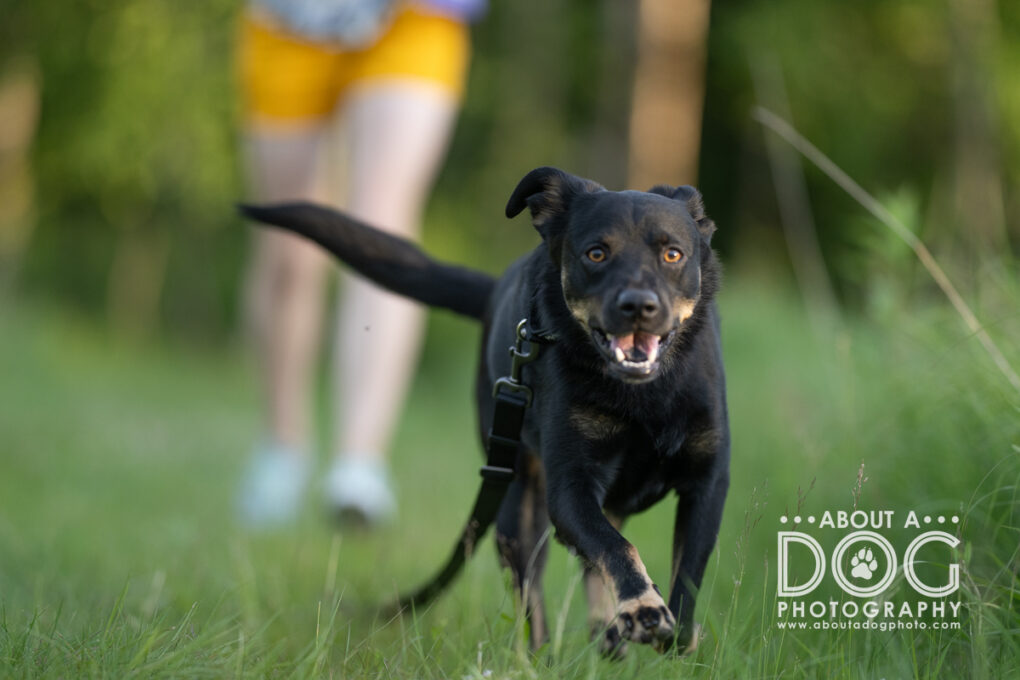
This is classic for fast moving dogs running towards the camera – autofocus picked up just behind Monkey Bars’ eyes & head. F1.8, shutter 1/2500, ISO 200.
How in heck do we fix blurry action photos of our dogs?
There are many ways! It really depends on the cause of the blur.
Blurry due to a lack of light?
Then we need to add light!
- Shooting between the golden hours, closer to midday will give you more light (but can have stronger shadows & harsher brightness)
- Upping your ISO will add light – ISO 100 to ISO 200 will double your light (each increase is a stop – so double the light)
- Wide apertures – f2.8, f1.8, f1.4 will let more light in – if your lens doesn’t have a wide aperture you will be limited
- Shutter speed will add light if you SLOW the shutter down – be cautious because too slow = more blur
Blurry due to too slow of a shutter?
Then we need to speed up your shutter!
- Shutter priority & manual mode will allow you to set a fast or slow shutter
- Set your shutter to 1/500th or faster (most cameras go to 1/4000 or 1/8000)
- Faster shutters = less light in to the sensor
— if you don’t add light (aperture or ISO) or don’t have enough available light your image can be rather under exposed - Shutter speeds change in stops – full stops are 2x more light for slower or half as much light for faster
(shutter speeds also have half stops and third stops like aperture!)
Blurry due to incorrect focus?
Here’s a quick troubleshooting autofocus guide:
- Look for your viewfinder, half press your shutter – what does the autofocus boxes look like? A cluster? Big box? Change it to a single point!
(PRO TIP: Animal eye detection MAY but also MAY NOT help track moving dogs – Canon, Sony mirrorless & Nikon mirrorless & DSLRS all have eye detection & tracking modes. Google animal eye detection on getting the perfect settings for your camera.) - Check your autofocus mode. Make sure you are in a continuous focusing mode.
- Half press your shutter to engage in focusing or set up back button focus. Keep the half press or back button pushed to keep autofocus engaged.
- Double check that your lens hasn’t been bumped into manual mode (we’ve all been there!)
** NOTE: dogs running towards the camera may still be a struggle for autofocus modes, especially the faster the dog. Sometimes it simply comes down to timing. Fast frame rates (6 frames per second or faster) can help you get more keepers, but if your autofocus misses you’ll have a series of out of focus images!
A note on location
Action can be done in any location! Wide spaces gives your dog ample room to run, chase a ball and go wild with zoomies. Theodore Wirth Park just outside the Twin Cities has a HUGE open area your dog can let loose! Millstream Park in Saint Joseph also has a HUGE open grassy area (be on the lookout for disk golfers!). The drawback for wide open spaces is your dog might opt for even more chaotic movement.
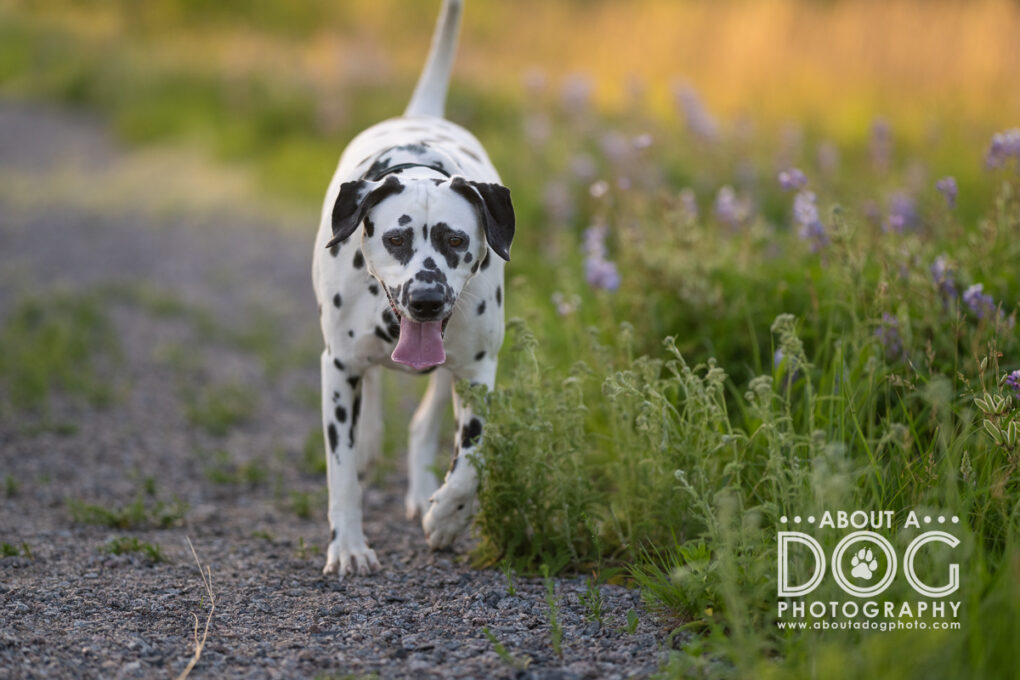
For a wrangled action series, look for paths. These could be paths cut through grasses, woods, parks and surrounded by grass, woods, or even urban environments. Paths give you a natural leading line to draw the eye to your dog’s action plus they give your dog a visual path to follow as they trot, stroll or run.
Note: longlines will be your friend. Most parks do require dogs to be on leash while in and enjoying the park. Shorter, walking leashes work if you are personally up for a sprint, otherwise long lines – 10ft or longer – will give your dog some extra room to run but still be on leash.
PRO TIP: Bring a spare set of hands! These extra hands can hold your dog, then release them for an epic run towards us image of your dog running to you. Or the extra set of hands can catch your dog as they breeze past in pursuit of a ball or toy.
Quick Cheat Sheet!
- Freeze motion: 1/500 – 1/4000 < the more available light, the closer to 1/4000 you can be
- Wide aperture: f2.8 or wider, lens dependent
- ISO: 400-800 or higher, depending on your available light
- Lens: 75mm or longer, 135mm, 200mm & 300mm will be stellar sweet spots
- Focus mode: continuous with a single focus point, set up back button focusing
- Frames per second: at least 6 frames per second, faster will capture more action
- Control your shutter: Tv / S mode or Manual mode (Tv on Canon = time value aka shutter priority)
Continue Learning:
If you’d like another perspective on action dog photography, here are a few resources I found helpful while researching this article.
- Tips for Running Dogs from Inspawration Photography – Emily taps into dog photographer Chris van Riel for a plethora of dogs in action tips
- How To: Photograph Dogs Running by That Tog Spot – Jessica not just written, but videos about action too!
- 7 Steps for Run to Me Action by Charlotte Reeves on the Unleashed Education website – stunning action examples with settings for each image
- Photographing Your Dog in Motion: Easy Tips for Playful Photos by About A Dog Photography (me!)
This post is the June theme for the monthly photography challenge I’m doing with Kasey of Kasey Wilson Photography. We each interpreted the theme of Action in our own unique way. Head to Kasey’s blog to see her take on action dog photography!
Action dog photography isn't easy
Dogs in action is one of the trickiest types of dog photography to master. I hope these help you troubleshoot blurry photos and capture more successful action photos of your dog.
And if you’d rather spend your time cheering on your dog than worrying about shutter speeds and camera settings, I’m here to help!
Book a About A Dog Photography session and we’ll create some EPIC action portraits together!